

Welcome Avatar! On Monday April 27, 2026, President Milei signed Decree 285/2026 and appointed Aixa Granara as Executive Director of the Agencia de Programas de Ciudadanía por Inversión, the agency in charge of running Argentina's Citizenship by Investment program. This Ad honorem appointment was published in the Official Gazette on April 28.
After the international tender to design the CBI was killed two weeks ago (covered here in Argentina Just Killed the CBI Tender), I ended that piece with a line worth repeating:
The door to the Argentine passport is technically open. Practically, nobody is at the desk.
Well, somebody is now at the desk. Congratulations to Aixa Granara on the appointment, and good luck. The job in front of her is a serious one and the clock has been running for almost a year already.

A Quick Recap
For anyone just tuning in, the short version is in three previous articles:
Argentina’s 5,000-Slot Citizenship Gold Rush, where the original tender was launched and we walked through it completely.
Argentina’s Citizenship Gold Rush, covering the six firms that submitted bids in January.
Argentina Just Killed the CBI Tender, covering the April 14 cancellation.
The state of play right now is this: Milei’s original Executive Order 366/2025 from May 2025 created the legal structure for the APCI agency and Argentine CBI as a concept.
That decree is still in force, even though the master tender that was supposed to outsource the design and operation of the program to a single international firm was killed this month, which also undid the outsourcing of the design and operation of the program to a single international firm.
That tender attracted six bids, two finalists, and a $50,000 vs. $25 million pricing gap so wide that the Ministry of Economy chose to kill the entire process rather than award to either side.
Now the agency has its first Executive Director. What the agency does not have is a regulation, an operating procedure, an investment threshold, or an open application window. Until those program requirements are in place, no CBI applications can be processed.
That is what needs to change quickly.
The 5,000-Slot Cap Is Gone
Here is the underreported point that almost nobody in the IMI space has picked up on. The 5,000-application cap on the Argentine CBI program was a feature of the cancelled tender, not of the underlying decree.
Look at the original tender language we quoted in the 5,000-slot article:
Processing up to 5,000 applications, with the contractor issuing “circumstantiated reports” recommending approvals. The contract lasts 4 years from the start date or until 5,000 approval reports are issued by APCI, whichever comes first.
That cap was contractual: it was the maximum number of applications the master agent was being hired to process over the four-year contract window. With the tender cancelled, that cap died with it.
That changes the math significantly. Forbes, in a September 2025 article, already flagged that Argentina could outperform Turkey and Malta on volume. Turkey reached 40,000 CBI applications in roughly five to six years. Dominica passed 30,000 in four years. The US EB-5 visa, which gives residency rather than citizenship, runs above 9,000 applications per year with multi-year waits.
If Argentina handles the regulatory side properly and pulls 5,000 applications a year, that is a potential USD 2.5 billion in foreign direct investment annually at the USD 500,000 minimum. If the program even approaches Turkish-level volumes, the numbers get a lot more interesting than that.
Now that the cap is technically lifted, the real question is whether the new regulation will reintroduce one, or let the market decide. The answer should be the second.
The “Poco Serio” Problem
There is a Spanish phrase that captures the issue here better than anything in English: poco serio. It translates roughly to “not serious” but carries a specific weight when used about institutions or governments. It is the polite way of saying “amateur hour.”
Eleven months have passed since Decree 366/2025 was signed in May 2025.
In that time, the Argentine CBI program has not received a single application, because there is no regulation, no published investment threshold, no open file procedure, no nothing.
To the international investor community, this is starting to feel poco serio. I have spoken to several potential investors over the last few months who have stopped asking when the program will open and started asking whether they should bother waiting for it at all. Argentina is competing for capital with Turkey, Malta, the Caribbean programs, EB-5 in the United States, and a handful of European Golden Visas. The longer this takes, the more capital ends up parked elsewhere.
The fiscal residency piece, which we covered in Argentina CBI Fiscal Residency Solution, is already in place. The labor reform fixed the tax-residency-by-naturalization problem, but what is missing is the regulation that turns the decree into a working program.

There is one piece of good news on the parallel naturalization track. In the last two weeks, immigration lawyers in Buenos Aires have started reporting that Migraciones is actually setting up the kiosko for regular citizenship applications, the one that was supposed to exist a year ago when Decree 366/2025 moved processing from the federal courts to Migraciones.
That is real progress on regular naturalization, but now the CBI side needs to catch up.
What a Serious CBI Regulation Should Look Like
Behind the scenes, this rodent has been working with experienced immigration experts on a proposed text for the CBI regulation. The full draft is downloadable below, in both Spanish and English.
Rather than a boring walk through for every one of the 30+ articles, I will point out a few of the most important proposed articles, and explain the reasoning behind each.
Categories of investment with clear thresholds
The proposed regulation defines seven investment categories. The amounts are calibrated to international comparables and to the specific behaviors the program should incentivize:
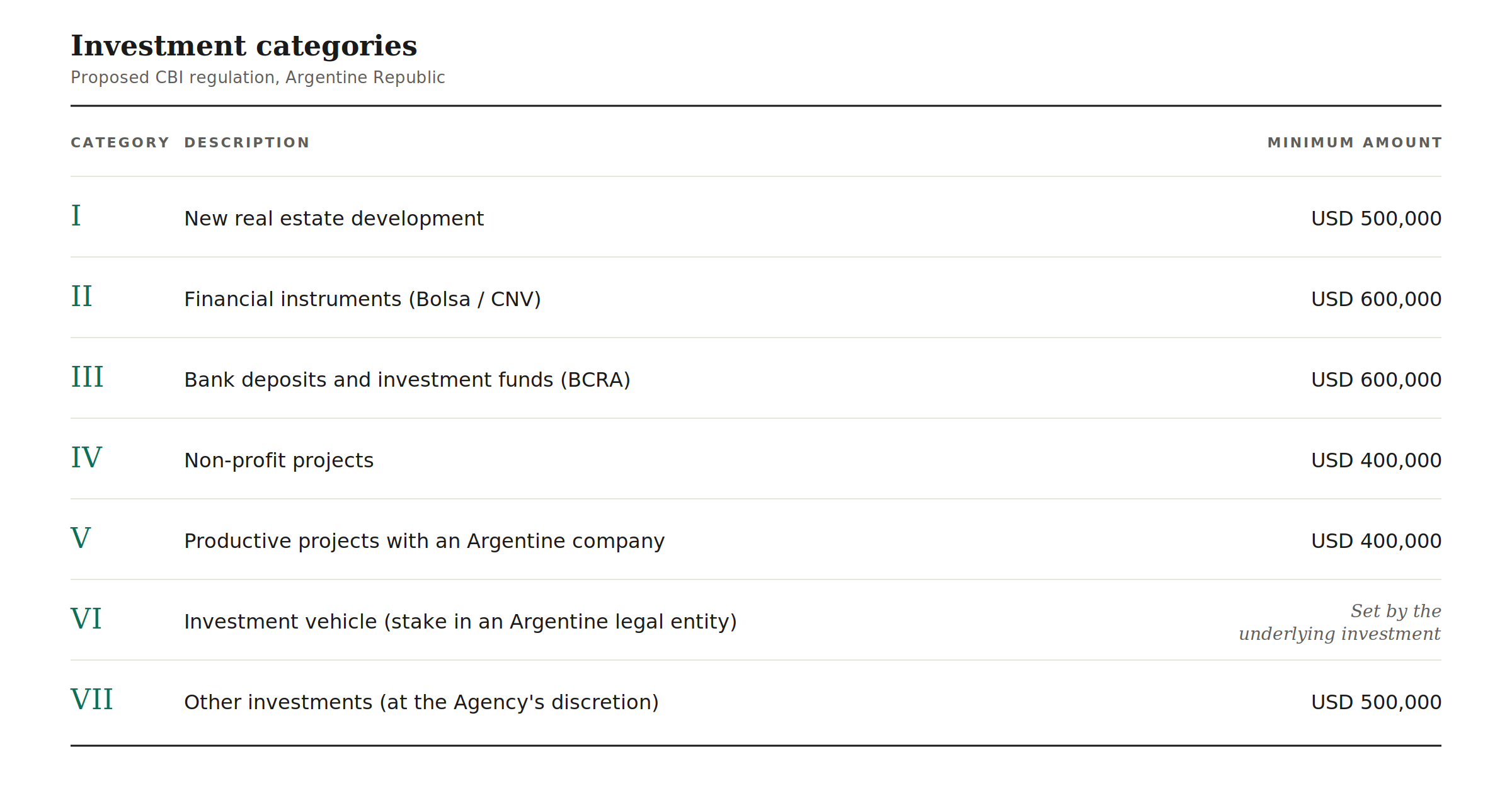
The category structure does the work that a well-designed program should do. It pulls capital toward new construction and productive projects (lower thresholds for joint ventures with Argentine companies and non-profits) and away from passive secondary-market real estate flips.
The requirement that real estate be “new”, defined as construction with municipal permits dated after January 1, 2024, blocks resale arbitrage and indirectly prohibits raw rural land purchases, sidestepping the political nightmare of “the gringos are buying our land.”
Who can apply
The proposed regulation lets nationals of countries whose citizens do not require a visa to enter Argentina apply directly from inside the country. The category is designed to invite most of the OECD plus the Caribbean and Latin America to look at Argentine investment opportunities, with the door already open and the paperwork already simple.
For nationals of countries that do require an Argentine visa, the proposal includes a consular track. They can apply for the CBI through the Argentine embassy in their jurisdiction with a fully documented investment project and the corresponding fees. If approved, they receive a business visa to enter Argentina and execute the investment. This keeps the door open for serious investors from anywhere in the world without compromising the visa-waiver-country structure.
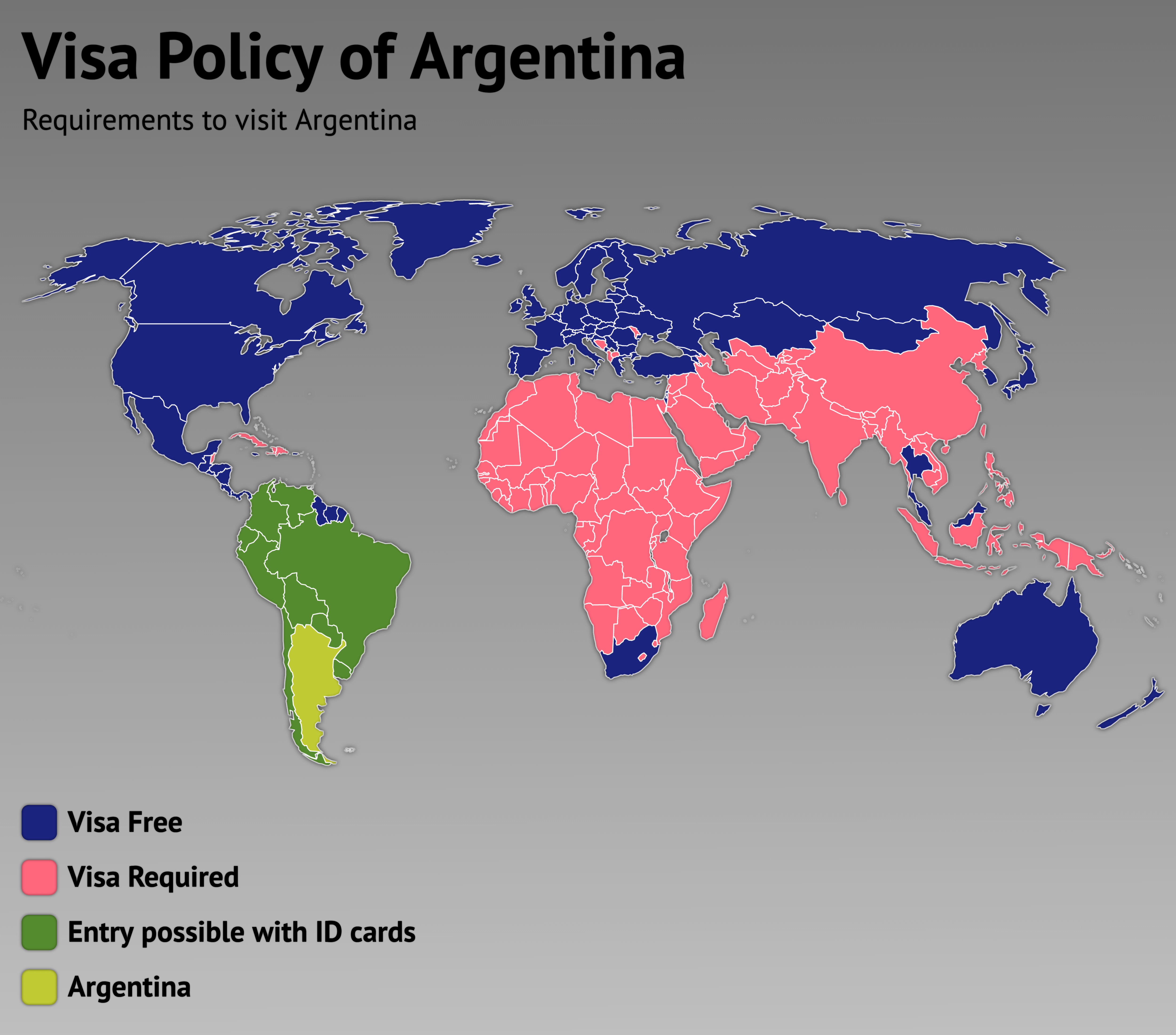
This is not a new criterion. It is already used elsewhere in Argentine migration law, and the proposal is aligned with the direction of recent regulation in this area, including Disposición 1520/2024 on category-change requests inside the country.
Family inclusion without re-paying the full investment
The proposal extends CBI to the principal applicant’s spouse or partner, minor children, dependent adult children up to age 25 if studying, and dependent parents over 55. No additional investment is required per family member, only the individual processing fees. The Agency retains the right to set additional fees or top-up investments for specific categories of dependents.
This matters because every serious CBI program in the world operates this way. Forcing a USD 500,000 investment per family member would price the program out of the market and make Argentina look like a country that does not understand how this industry works.
Three-year fund permanence with 30% upfront
The investment must remain in the country for three years from the date of application. The applicant can open the file with 30% of the funds already deposited and committed, with the file held at the Agency until 100% of the investment is verified. Only then is it sent to DNM for the actual citizenship grant.
Three years is the international standard. The 30% rule lets serious investors start the clock without parking the full amount on day one, while protecting the program from straw-man transfers.
The anti-fraud article
Article 20 of the proposal is the single most important piece of fraud protection in the entire text. It explicitly prohibits any operation in which the receiver of the investment commits, expressly or tacitly, to return the funds to the applicant without the actual execution of the investment plan. The text of this article must be transcribed verbatim into the investment contract, under penalty of the file being rejected.
This is the article that prevents the obvious scam: paying USD 100,000 to a property owner to “sell” you a USD 500,000 apartment that gets quietly bought back six months later. Every CBI program in the world has seen this exact maneuver. The Argentine version preempts it at the contract level.
Pre-approval regime for projects
The proposal creates a voluntary pre-approval registry where Argentine companies can submit investment projects to APCI in advance, pay a fee, and receive a certificate of pre-approval. Projects under USD 5 million get a six-month certificate; projects above that get up to a year. Renewable.
This serves three purposes at once. It gives investors confidence that the project they are putting money into has already been reviewed by the Agency. It reduces APCI’s per-applicant workload because the receiving entity has already been vetted. And it generates additional fee revenue for the Agency. Mid-size and large Argentine companies can actively seek out CBI capital with a credible certificate in hand, federalizing the investment flow beyond Recoleta and Puerto Madero.
Investment Responsibles with annual reporting
Every project that receives CBI capital must designate one or more “Responsables de la Inversión,” senior people inside the receiving company who are legally accountable for the execution of the investment. They notify APCI of any breach, file a detailed investment plan per applicant, and submit annual reports on the use of funds for the first three years. They are jointly liable for damages from any breach.
This is the accountability backbone that the Caribbean programs have historically lacked and that the Maltese program has been hammered for. Putting a named, legally exposed individual on the receiving side prevents the “the developer disappeared with the money” scenario that has burned investors in other jurisdictions.
Constitutional and Reputational Guardrails
A few of the design choices above deserve a second mention because they protect the program politically as much as legally.
Article 25 of the Argentine Constitution explicitly mandates the encouragement of foreign immigration of those who come to “labor the land, improve industries, and introduce and teach the sciences and arts.” A well-designed CBI regulation answers that mandate directly. This is not a controversial constitutional reading. It is the explicit text.
The visa-waiver-country criterion protects the strength of the Argentine passport. Argentina is currently in active negotiations for entry into the US Visa Waiver Program. A CBI program open to anyone with USD 500,000 would jeopardize those negotiations overnight, and could also complicate EU Schengen access.
The proposed criterion keeps the door closed to the kind of citizenship arbitrage that has triggered EU and US sanctions against several Caribbean programs over the last decade (EU canceled visa-free entry for Vanuatu, mainly due to CBI price concerns, and hinted that Caribbean CBI islands better increase their investment thresholds to maintain visa-free entry, which they promptly did).
The three-year fund hold and the Article 20 anti-fraud language protect the Argentine state from the “we sold our passport to anyone” perception that has haunted Malta, Cyprus, and several other programs. The federalization of investment, baked into the Category V joint-venture structure with Argentine companies, keeps the program from becoming a Recoleta and Puerto Madero subsidy.
These are not bureaucratic flourishes, but the difference between a program that survives the next election cycle and one that gets unwound by the next administration.
Downloads
The full proposed regulatory text is available below in both Spanish and English. The Spanish version is the document that has been workshopped with experienced immigration experts and is the operative text. The English version is a translation provided for the benefit of international investors, immigration lawyers, and anyone in the global RCBI community who wants to understand what a serious Argentine CBI regulation could look like.
Spanish Original:

English Translation:
If you are a policymaker at MECON, Migraciones, or APCI, take this as a starting point. The document is a structured proposal that can be modified, expanded, or rejected on its merits. Nothing in it is take-it-or-leave-it. The point is to give the agency something concrete to react to, rather than starting from a blank page after eleven months of stasis.
The Ask
I have worked in the residency and citizenship by investment industry for 10+ years and have been a resident in Argentina for over 20. The motivation here is simple: this country needs this CBI program to succeed, and it needs to launch quickly.
To Minister Caputo and to Aixa Granara: the proposal is on the table. Happy to walk through any section, discuss alternative structures, or connect you with the immigration experts who helped draft it. No fees, no compensation, no agenda beyond seeing this program work.
The door is open and somebody is finally at the desk. The 5,000-slot cap is gone with the dead tender, and the fiscal residency rules are in place. The naturalization kiosko at Migraciones is finally being set up. The pieces are coming together.
What is left is the regulation. Let’s get it done.
See you in the CBI Jungle, anons!
Other ways to get in touch:
1x1 Consultations: book a 1x1 consultation for more information about obtaining residency, citizenship or investing in real estate in Argentina here.
Propertyinbuenosaires.com: personal resource website with everything you need to know about buying and selling property in Argentina.
X/Twitter: definitely most active here, you can also find me on Instagram but I hardly use that account.
Podcasts: You can find previous appearances on podcasts etc here.
YouTube: Check out my channel for real estate info and more.
WiFi Agency: My other (paid) blog on how to start a digital agency from A to Z.
Here’s to hoping your message gets through! I’m waiting with my cash in hand for this to open.