

Welcome Avatar! Yesterday the Supreme Court threw out the case that had kept Cristina Kirchner’s rural land law alive. The Court ruled that territorial sovereignty belongs to the State, and just as Cristina implemented the 15% cap on foreign ownership, Milei could take it off.
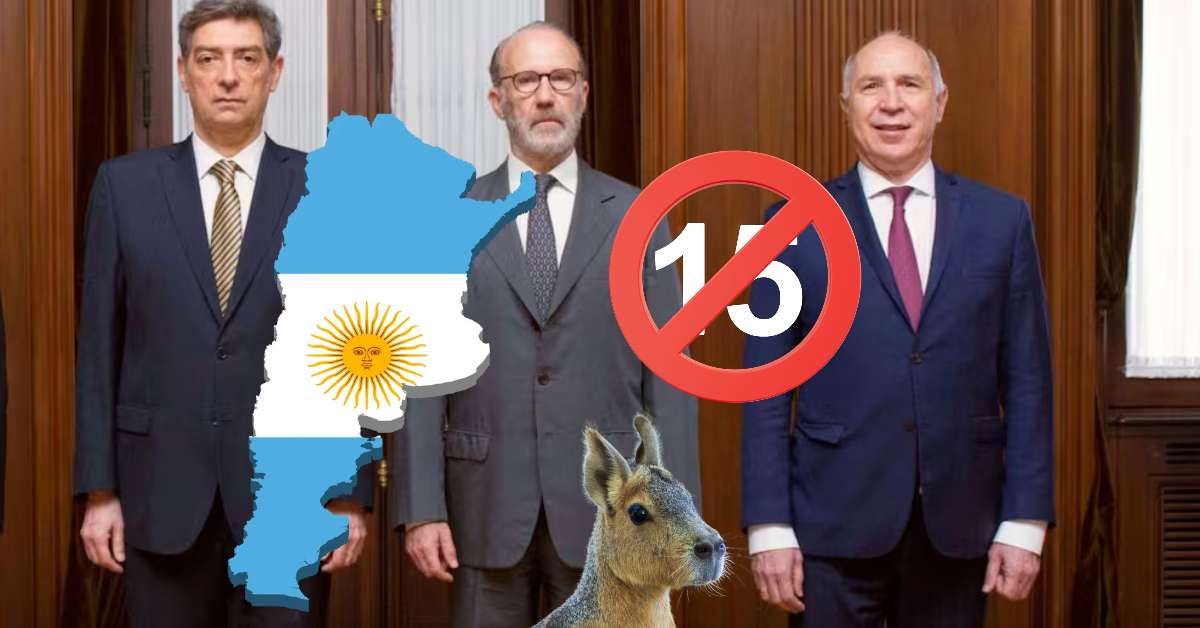
So as of this week, the article in Milei's December 2023 decree that repealed Law 26.737, is in full force.

One thing that the Supreme Court did not do is determine whether the section of Milei’s decree dealing with the Ley de Tierras is unconstitutional or not. The Court’s ruling effectively restores the validity of Federico Sturzenegger’s sweeping emergency decree, by reinstating the repeal of the regulation in its entirety (pending intervention by another court) on the grounds that the organization bringing the lawsuit lacked legal standing to do so.
In September 2025 I wrote that the Court would take years to come to a ruling around this case, but it has done so in 13 months (quite fast for Argentine standards).

What died on Tuesday
In 2012, the second presidency of Cristina Kirchner pushed through Law 26,737, which put into effect the “Regime for the Protection of the National Domain of Property, Possession or Tenure of Rural Land”, commonly known as the Land Law or Ley de Tierras in Spanish.
This law limited land sales to foreigners in Argentina to a maximum of 15% of the national territory and forces the provinces to report the amount of land in the hands of foreign individuals or foreign corporations.
Among other points, it established that a foreigner couldn’t have more than 1,000 hectares (2,470 acres) in a core agricultural zone (the best soil in northern Buenos Aires, southern Santa Fe and southern Córdoba).
Any one nationality, in turn, could not exceed 4.5% of the land of a department, a province or the country as a whole. It also prohibited foreigners from owning land containing (or bordering) large, permanent bodies of water; in Neuquén and Río Negro, this encompasses the vast majority of what anyone would wish to purchase.
In practice, no province ever got close to 15% foreign rural land ownership, as Minister Bullrich tried to point out during the debates around repealing or changing the law:
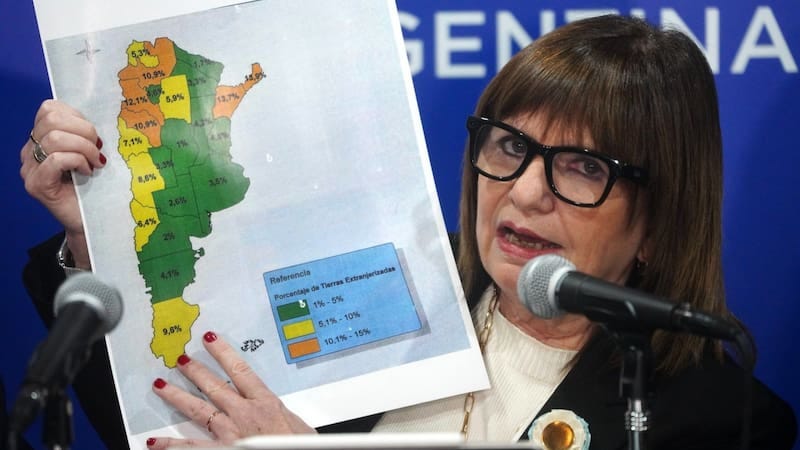
The full breakdown of who owns what, department by department, with the spreadsheet, is in Update on the Ley de Tierras. The property bill, what it wanted to do to this law and what survived the Senate, is in Private Property Reforms.
With this latest Supreme Court ruling reinstating Milei’s decree, all four restrictions from the old Ley are now gone, together with the authorization certificate from the Registro Nacional de Tierras Rurales, the piece of paper every rural escritura to a foreigner had to wait for (111 of them were issued in all of 2026, which tells you how many deals were actually moving).
Border Zones
What is still in force, is certain restrictions around foreign land ownership for border zones, which is a restriction many countries implement. Decreto-Ley 15.385 of 1944 wants property in the zonas de seguridad de fronteras in Argentine hands and requires a previa conformidad from the Interior Ministry before a foreigner or a foreign-controlled company can buy inside them.
These zones run up to 150km inland from the land border and 50km from the coast lines, and were redrawn in 2018 to leave out most urban centers.
Constitutional lawyer Andrés Gil Domínguez summarized it well in Río Negro this week:
Although the repeal eliminates hectare-based quotas, land acquisition in border areas remains subject to the Border Security Zones regime (Decree-Law 15.385/44), which requires foreigners to obtain prior authorization from the national government; in other words, while there is no cap on surface area, there is a case-by-case assessment based on defense considerations.
Argentina joins the rest of Latam
The panic campaign in July, with Lali Espósito's stories and Amnesty International videos, was focused around the narrative that a country without a foreign ownership cap is a country for sale.

Here is what the rest of the regions looks like without the cap:
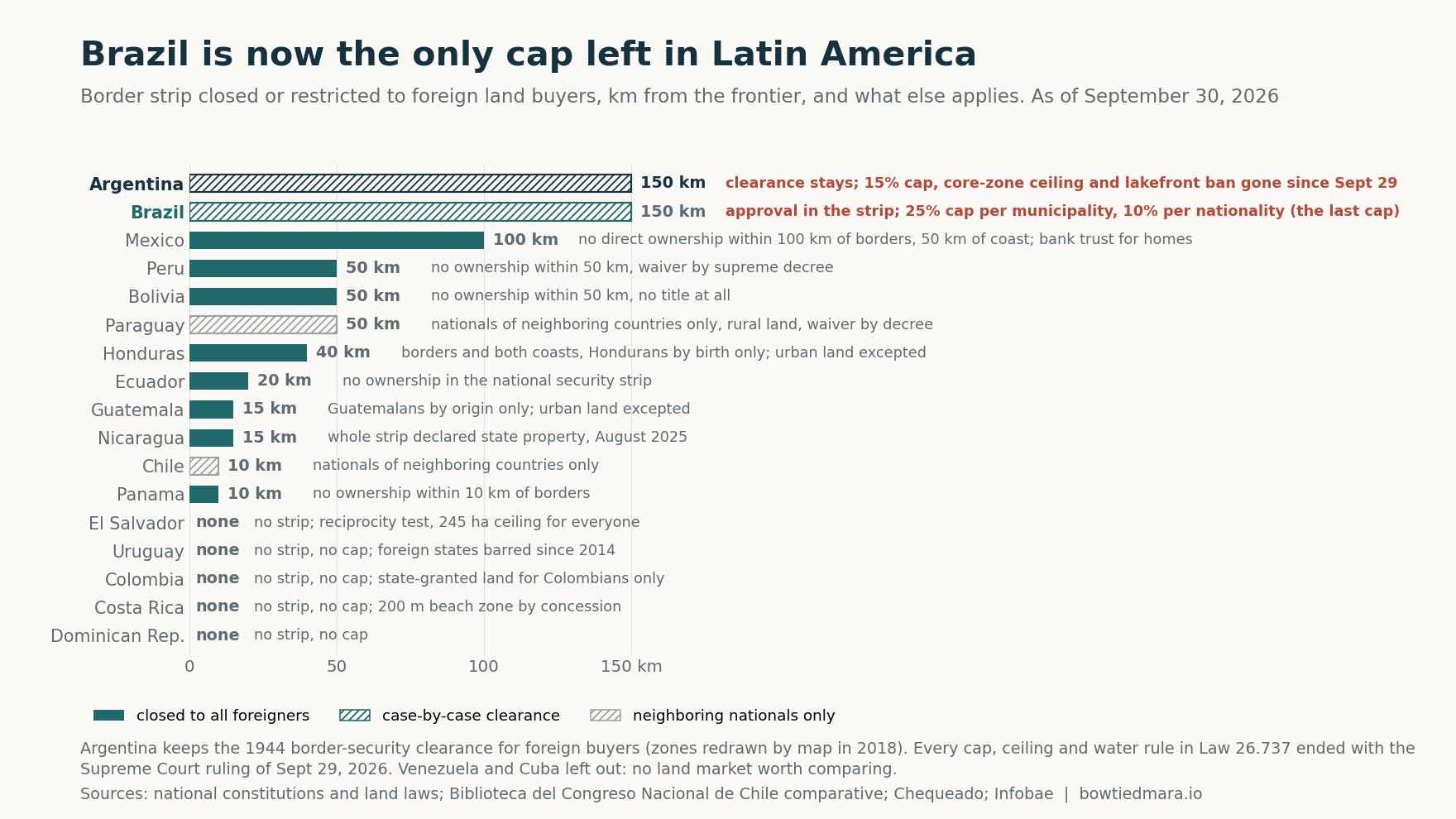
Brazil is now the last country in Latin America with a percentage cap on foreign land ownership: 25% of any municipality and 10% for any single nationality.
Every other country runs on border strips and nothing else, Argentina now included. Apart from Nicaragua, where the state declared its entire 15 km strip public property in August 2025, in all other countries there are certain border restrictions related to foreign ownership.
In the last 4 countries on the list, there are no restrictions at all. As I mentioned back in July with regards to the fear campaign around Argentina removing the 15% foreign ownership cap:
Uruguay is the comparison the Panickinians should be afraid of when it comes to their aversion to money moving in. There is no cap on foreign ownership in Uruguay, and between 2007 and 2020 foreign-controlled companies took control of roughly 7 million hectares, close to 40% of all the country’s farmland. This doesn’t seem to hold the country back in any way, shape or form. Uruguay is still Uruguay.
The only thing Montevideo ever banned was foreign states buying farmland, in 2014, and that is the one restriction Milei's decree also keeps under the 1944 clearance regime.
Final Thoughts
Less restrictions = bullish. The restrictions that remain in place are for border protection, which is something most bigger countries in Latam apply. Foreigners own roughly 5-6% of rural land in Argentina, and nowhere did foreign ownership even get close to the 15% cap.
Will that change now? I doubt it. For that to happen, Argentina needs to prove Milei’s reforms stick, and even then it is not very likely that percentage will ever get above 10% (for example in the US, where there is no cap either, the share is about 0.67%; direct foreign ownership of cropland and pasture alone is even smaller). If Argentina would ever get to Uruguayan levels, that would mean many foreign investors start betting on Argentina’s future and we could see an unprecendented investment boom.
If you were on the fence about buying in the zona núcleo or had a rural deal waiting on the certificate, it is safe to say you can call your escribano this week to start setting up the deed without the need of additional permits (only check left is whether the parcel sits inside a border security zone).
See you in the Jungle, anon!
Other ways to get in touch:
1x1 Consultations: book a 1x1 consultation for more information about obtaining residency, citizenship or investing in real estate in Argentina here.
Propertyinbuenosaires.com: personal resource website with everything you need to know about buying and selling property in Argentina.
ArgInvesting.com: new project — a mini-Bloomberg for Argentina. Live FX, BCRA, inflation and bond data with interactive charts, plus the full Macro Pulse report. Built off the Argentina Macro Pulse you’ve read here.
X/Twitter: definitely most active here, you can also find me on Instagram but I hardly use that account.
Podcasts: You can find previous appearances on podcasts etc here.
YouTube: Check out my channel for real estate info and more.
WiFi Agency: My other (paid) blog on how to start a digital agency from A to Z.