

Welcome Avatar! The wait is over: after going through the submitted proposals of the six RCBI firms in February, Argentina has selected the firm that will be responsible for structuring the country’s CBI program.

CBI Program Recap
In previous articles (see links at the bottom of this article), I’ve discussed the initial stages and creation of the CBI program, but in case you missed these here’s the overall timeline that lead to what will soon lead to the official launch of the program.
The legal foundation for Argentina’s citizenship by investment program was laid in mid-2025. Decree 366/25 modified Argentina’s Citizenship Law (Ley 346) to allow foreign nationals to obtain citizenship by naturalization, regardless of how long they’ve resided in the country. As long as they can can demonstrate a “relevant investment,” that is enough to apply for citizenship.

In July 2025 through Decree 524/2025, Milei established the procedural framework: applications would be received and evaluated by a new decentralized citizenship agency, the Agencia de Programas de Ciudadanía por Inversión (APCI), operating within the Ministry of Economy.
The APCI doesn’t act alone. Milei’s decree requires that before any citizenship is granted, the agency must request assessments from the Ministry of Security, the Financial Intelligence Unit (UIF), the National Registry of Recidivism, RENAPER, and SIDE (Argentina’s intelligence service/CIA), among other bodies. Of course this is standard process of the due diligence for most citizenship by investment programs.

While some Argentines have started to worry about the credibility of the Argentine passport once the CBI program is launched, the approval process will also take into account security protocols from third countries, including those applicable under a potential US visa waiver program.
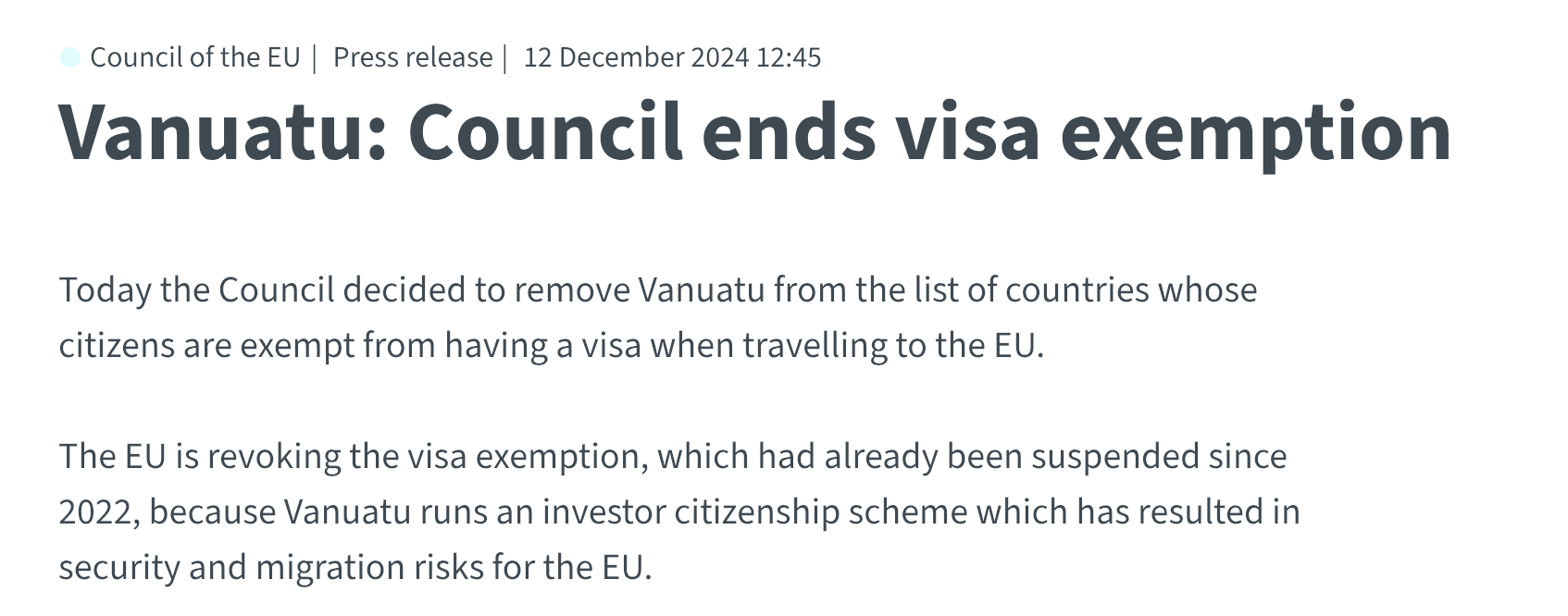
So Milei & Co are definitely aware of the importance of not staining the Argentine passport through a CBI program — some programs like Vanuatu have ran into issues like no more visa free travel to the EU because of the low investment amount and not enough due diligence in the application process.
In January of this year the Argentine government launched a tender to hire a master agent that will assist the APCI technically by designing, promoting, and operating the CBI program. The contract would run for four years (with an optional fifth) or until 5,000 citizenship approval recommendations are issued, whichever comes first.
This brings us to today.
Argentina’s Bid Evalutions
Four of the six original bidders were eliminated before scoring even began. The reasons for elimination were multiple according to IMI Daily:
Hong Kong Qian Cheng deposited its $1.25M guarantee into its own China Construction Bank account instead of the Ministry’s designated Banco Nación account, arriving ten days past the January 20 deadline. Besides the initial mistake, the funds not arriving on time looks like a typical wire transfer failure which are oh so common when interacting with Argentine banking system.
Salzburg International (Reach Immigration) uploaded a SWIFT bank guarantee but never delivered the physical document with the required translation and certification, and in Argentina the government still loves paper and stamps (certified translations).
Latitude Consultancy failed financial solvency thresholds; its indebtedness ratio was 1.36 (max 0.50) and solvency ratio was 1.73 (min 2.00).
Ancova Associates was disqualified for submitting a “Rectification” that amounted to modifying its original bid (violating the immutability principle), and separately failed the minimum profit-to-sales ratio.
The Fantastic Four
In the bid evaluation report dated March 5 and published on the government’s COMPR.AR procurement portal, the Ministry recommended awarding the CBI master agent contract to a four-company consortium operating under the name Asesorías Legal Advisor Limitada – UT Consorcio AAPA.
This consortium brings together four RCBI firms: Apex Capital Partners, AIM Global, Passport Legacy, and Arton Capital.
The group finished first with a total score of 88 points out of 100. Henley & Partners, the only other bidder to survive the admissibility stage, came in second with 48.09 points.
The consortium that submitted the winning bid had already been positioning itself publicly in Argentine media well before the bid evaluation was released. In a widely shared Infobae article from January 28, leaders of the consortium made their case for the program’s potential.
Matías Apparcel, the Chilean lawyer who serves as CEO of AIM Global, emphasized the strategic opportunity for Argentina to direct capital toward key sectors. Apparcel pointed to the US EB-5 residency by investment model as a precedent, noting that the American program has attracted between $55 and $60 billion since its creation and generated hundreds of thousands of jobs:
“The key lies in the commitment to the country and the possibility that the Government will direct the funds towards strategic sectors such as infrastructure, energy, agribusiness, technology, housing and regional development projects.”
— Matías Apparcel, CEO de AIM Global, quoted in Infobae
Nuri Katz, the founder and CEO of Apex Capital Partners, framed the challenge in terms of institutional design rather than just capital attraction. Speaking to La Brújula 24, Katz stressed that the program’s success would depend on building it with strict controls and clearly defined investment objectives, and that Argentina’s challenge was to make the program synonymous with transparency and quality in the eyes of the global community.
Jeffrey Henseler, Chairman of Passport Legacy — the Swiss firm that recently implemented a fully private CBI agency in São Tomé and Príncipe — described the CBI model as widely validated globally and backed by regulatory frameworks across more than 80 countries.
According to estimates from the consortium’s own teams, as reported by Infobae, the program could channel more than $2.5 billion in foreign direct investment in its early stages and attract around 5,000 families seeking Argentine citizenship through qualifying investments.
Two Finalists
Both Henley & Partners and the Consortium scored identically on the technical evaluation (80/100, weighted to 48 points each out of 60).
The consortium was praised for its interdisciplinary multi-firm structure and scored highly on singularity, expertise, and international network, though some members' experience documentation leaned on generic licensing arrangements. It was a smart move to team up between multiple firms, and Arton Capital and Passport Legacy were the ones credited with actual program implementation.
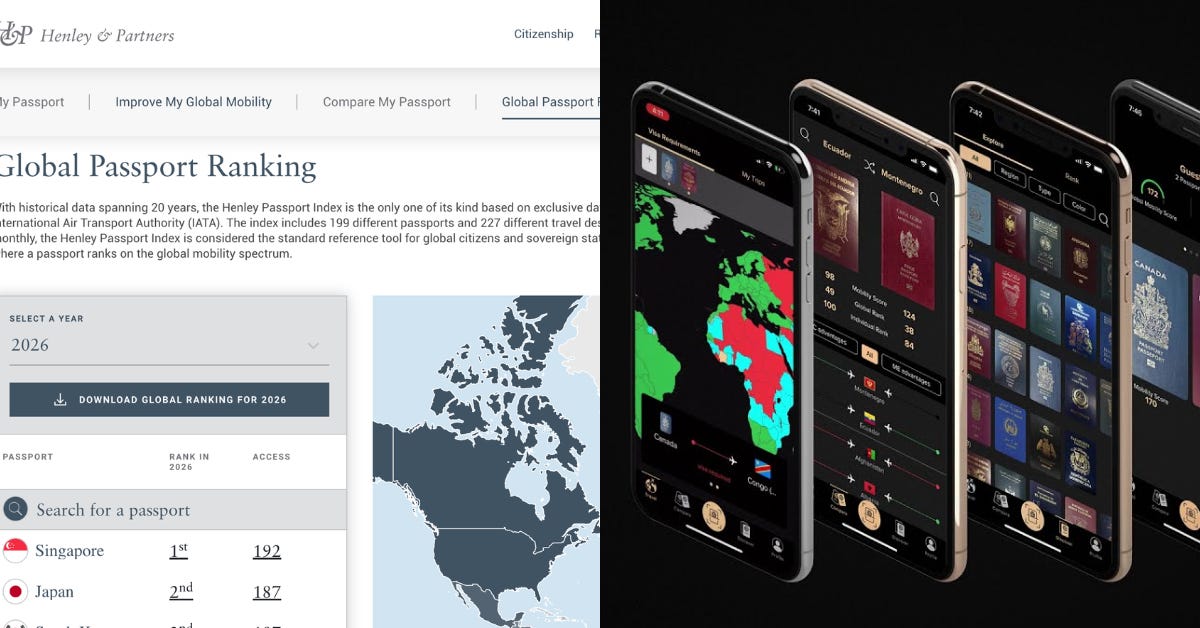
Henley & Partners brought contracts with at least seven governments dating to 2017, but evaluators flagged its proposed financial execution model as cumbersome for Argentina's public sector framework and its projected costs as elevated.
Eventually, for the Argentine government, it came down to price:
The consortium bid $10,000 per tranche across all five tranches of 1,000 applications each, totaling $50,000 for the entire contract. Henley bid $2 million for the first tranche, escalating to $8 million for the fifth, totaling $25 million.
After applying the weighted coefficients specified in the tender, the consortium’s offer produced a weighted total of $75,000; Henley’s came to $33.75 million. Under the scoring formula, which divides the lowest weighted bid by each bidder’s and multiplies by 100, the consortium received a perfect 100 on the economic component (reduced to 40 after the 40% coefficient). Henley received 0.2222, reduced to 0.0889.
Final scores: Consortium 88.00, Henley 48.0889.
The Fiscal Residency Fix
I wrote about this last week but it remains one of the most important changes that Argentina has implemented for the CBI program, which it cancels automatic tax residency — one of the CBI program’s single largest fiscal obstacles.
Normally, obtaining citizenship by naturalization would make you an Argentine national for tax purposes, meaning a CBI investor who never sets foot in the country beyond the application process would suddenly owe taxes to AFIP (now ARCA) on every dollar earned anywhere in the world. For a program trying to attract high-net-worth individuals, this was a dealbreaker.
Unfortunately that deal breaker is not available for this rodent as a permanent resident, lol.
Autist note — you can find an overview of the main Argentina CBI articles here:


Next pasitos for the CBI Program
The master agent recommendation is not yet a final award. Under Argentina’s procurement rules, bidders have three days from the communication of the evaluation report to file challenges. Once any challenges are resolved and the contracting authority issues a formal adjudicación, the consortium will take on its mandate.
The scope of that mandate is significant: the consortium will be building Argentina’s CBI program essentially from scratch.
Investment thresholds, eligible sectors, processing routes, and other program parameters remain undefined and we still have no idea of the investment requirements that Consortium will recommend for this program.
The master agent will design all of it.
What the consortium has publicly signalled, is a vision centered on directing investment toward infrastructure, energy, agribusiness, technology, housing, and regional development (see quote above).
The CBI program sits alongside the existing RIGI program (Régimen de Incentivos a las Grandes Inversiones) as part of a broader strategy to attract foreign capital under the Milei administration. These two could potentially be tied together, although the RIGI program was recently extended for only another year, so the window for matching the CBI investments with the RIGI program might be a bit tight.

What About Citizenship Without Investment?
The CBI option is a shortcut for people who would otherwise have a hard time qualifying for Argentine citizenship since Milei made the citizenship through residency process more difficult in May 2025: you can only apply if you have legal permanent residency, and haven’t been out of the country in the preceding two years.
For non-Mercosur citizens, this effectively means 3 years, since that is the timeline to get permanent residency (for Mercosur it is 2), and then not leaving for the last 2 years. Very unrealistic for most people who need to travel for business and family every few months.
So if that is a hurdle — which it will be for the vast majority of foreign residents in Argentina —, then the CBI is the only alternative to get Argentine citizenship, although it is capped at 5,000 passports (for now).
To make matters worse for people who plan on applying for citizenship through residency, my immigration contacts told me that the citizenship office at Migraciones basically does not really exist / do anything yet in practice.
So since May 2025, Argentina has not been issuing new citizenships/naturalizations unless these were started through the previous judicial process that was in place before Milei changed the application procedure to Migraciones — you are reading one very happy rodent who applied just 2 months before that change. I am still waiting on my appointment with a judge, now a full 12 months into my initial application, lol.
Final Thoughts
Argentina’s CBI procurement has been one of the most closely watched processes in the investment migration space. It is a unique way to structure a citizenship by investment program, and in my opinion this will pay off. It is a lot smarter to let experts in the space design a program vs leaving it to government bureaucrats who have no idea of the ideal structure for the CBI investor persona.
With the fiscal residency obstacle now legislatively resolved, the two biggest question marks hanging over the program have been addressed in the same week: 1) who will run it, and 2) whether holding the passport will trigger worldwide taxation.
The answer to the first is a four-firm consortium. The answer to the second is no (unless you decide to stay in Argentina for more than 12 months).
See you in the Jungle, anon!
Other ways to get in touch:
1x1 Consultations: book a 1x1 consultation for more information about obtaining residency, citizenship or investing in Argentina here.
March 2026 Event: The Wandering Investor Live Group Trip: Buenos Aires 2026. Get tickets here. (SOLD OUT)
X/Twitter: definitely most active here, you can also find me on Instagram but I hardly use that account.
Podcasts: You can find previous appearances on podcasts etc here.
YouTube: Check out my channel for real estate info and more.
WiFi Agency: My other (paid) blog on how to start a digital agency from A to Z.