

Welcome Avatar! Yesterday, April 14, 2026, the Argentine Ministry of Economy quietly signed Resolution 522/2026 and pulled the plug on the international tender for the country’s Citizenship by Investment program. No press conference. No tweet from Caputo. Just a four-page document uploaded to the official registry, written in the kind of bureaucratic Spanish that is designed to make your eyes glaze over before you reach the part that matters.

Most of you reading this have been following the CBI saga for months. If you haven’t, the short version is in Argentina’s Citizenship Gold Rush and Argentina CBI Fiscal Residency Solution. The program was supposed to be Argentina’s first formal investor citizenship route, run by a new agency called the APCI under the Ministry of Economy, capped at 5,000 approvals over four years.


That program, as designed, is now dead. Here we go.

What the resolution says
You can download the official resolution here:

The official document (RESOL-2026-522-APN-MEC) cancels Concurso Público N° 34-0001-CPU25, the international tender that was supposed to pick the consulting firm to design, launch and run the entire CBI operation.
Six firms bid back in January 2026. By March, the Evaluation Commission had recommended a winner. By April, the whole thing was in the bin.

The reason given in the resolution is masterful jerga oficial:
“...subsisten divergencias relevantes en cuanto a los enfoques propuestos y su adecuación integral a los objetivos de la política pública a desarrollar.”
Translated: relevant divergences persist regarding the proposed approaches and their integral adequacy to the public policy objectives being developed.
In plain English: the bids didn’t actually match what the government needs. So they killed the tender, returned the bid guarantees, and walked away. No compensation owed to anyone. Article 20 of Decree 1023/2001 lets them do exactly this.
The Bidders, and why most of them got tossed
Six firms showed up at the January 20 opening:
Hong Kong Qian Cheng Business Co., Ltd. (China)
Latitude Consultancy Malta Limited
Salzburg International for Law LLC (Reach Immigration)
Ancova Associates FZCO (UAE)
Henley & Partners Immigration Services FZCO
Asesorías Legal Advisor Limitada (Chile)
Four of them were eliminated before the real evaluation even started:
Hong Kong Qian Cheng wired its $1.25M bid guarantee into its own account at China Construction Bank instead of the Banco Nación account specified in the pliego. The funds arrived ten days late. Disqualified.
Salzburg International uploaded a SWIFT bank guarantee to the COMPR.AR system but never delivered the physical document with proper translation and certification. Disqualified.
Latitude Consultancy failed the financial solvency tests. Indebtedness ratio came in at 1.36 against a maximum of 0.50. Solvency ratio was 1.73 against a minimum of 2.00. Numbers do not lie.
Ancova Associates submitted a “Rectification of the Technical and Financial Proposal” when asked for clarifications, which the evaluators ruled was a modification of their original bid. Argentine procurement law has a principle called inmodificabilidad de las ofertas. You cannot change your bid after submission. Disqualified.
That left two finalists: Henley & Partners and Asesorías Legal Advisor Limitada.
The Chilean front
Now here is where it gets interesting. The Chilean firm was not really a Chilean law firm doing this alone. It was the legal vehicle for a four-firm international consortium operating under the structure Asesorías Legal Advisor Limitada – UT Consorcio AAPA. The “UT” stands for Unión Transitoria (temporary joint venture) and AAPA is the acronym of the four firms involved.
Per IMI Daily’s reporting on the March 5 evaluation report, the four firms behind the Chilean shell were:
Apex Capital Partners
AIM Global
Passport Legacy
Arton Capital
A consortium of four investment migration firms, fronted by a Chilean limitada to clear local procurement requirements. Smart structure. Probably saved them weeks of paperwork. Until it didn’t.
The Bid Gap
Both finalists looked roughly equal on paper. Henley & Partners and the Chilean-fronted consortium scored identically on the technical evaluation, until the envelopes with the prices came out.
As noted in the IMI Daily article, the bids diverged quite a bit:
Where the bids diverged was in price. The economic evaluation, weighted at 40% of the total score, overwhelmed Henley’s position.
The consortium bid $10,000 per tranche across all five tranches of 1,000 applications each, totaling $50,000 for the entire contract. Henley bid $2 million for the first tranche, escalating to $8 million for the fifth, totaling $25 million.
So much so that the spread was 500x between the two:
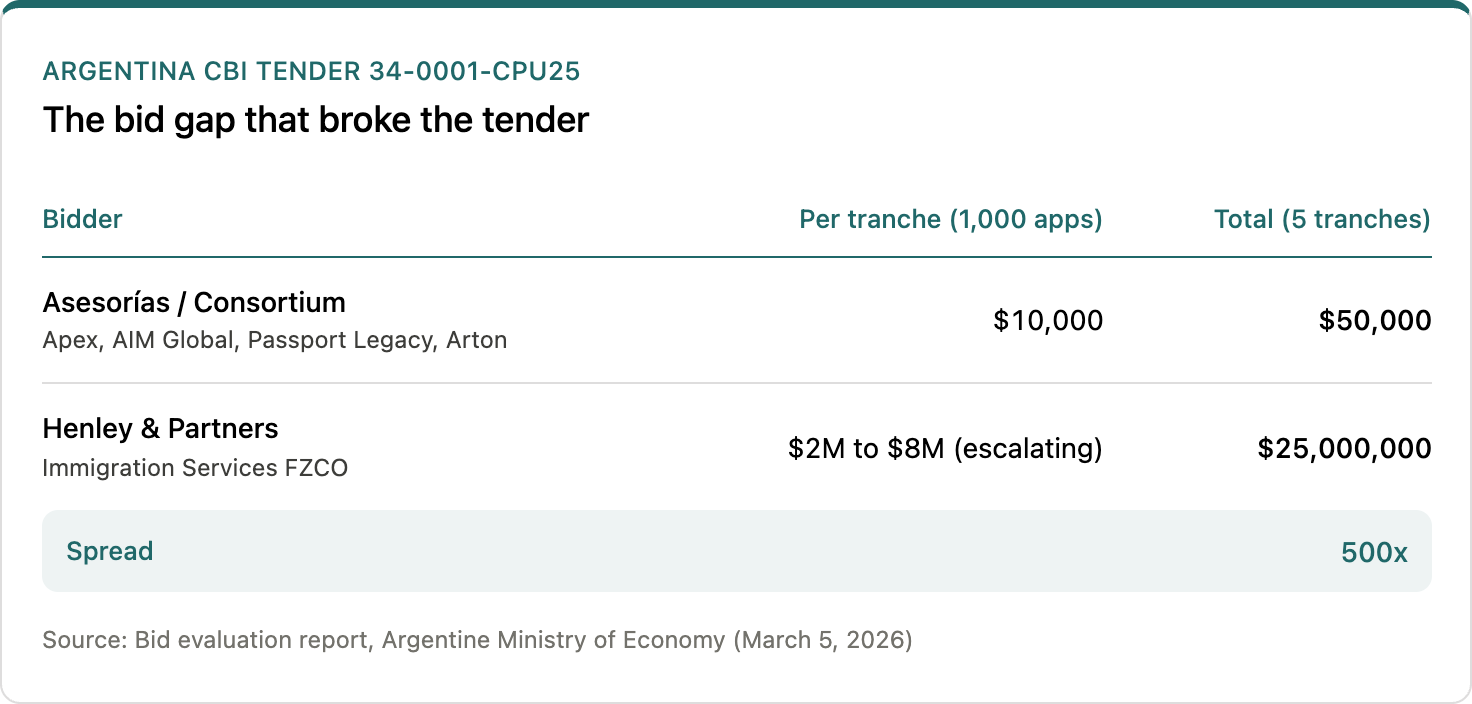
That is not a typo. The consortium offered to design, launch, promote and run Argentina’s entire CBI program for four years for fifty thousand US tokens. Henley wanted twenty-five million.
So either the consortium was promising to do the job for less than the cost of a used Toyota Hilux in Palermo, or Henley was charging Argentine government rates because they assumed Argentina would pay them. Neither read flatters anyone involved.

The math from there was a formality. The consortium won the price round by such a wide margin that nothing else mattered. They walked away with the recommendation, Henley filed an impugnación, and somebody at MECON finally sat down and asked what fifty thousand dollars actually buys you when you’re trying to attract five thousand millionaires to a country like Argentina.
The answer, apparently, was: not enough.
Why the government walked away
Read the timeline carefully:
March 5, 2026: Evaluation Commission recommends awarding to the consortium.
March-April 2026: Henley & Partners and Latitude both file impugnaciones (formal legal challenges) to the award.
April 14, 2026: Minister Caputo signs a resolution killing the entire tender, citing “strategic and policy concerns.”
The resolution does not say it directly, but the pattern is obvious: after the impugnaciones came in, the Legal and Administrative Secretariat of the Ministry took another look at the actual proposals.
Their conclusion, per the official text, was that “the continuity of the procedure under the current conditions could not ensure the degree of coherence, integrality and strategic articulation required for the adequate implementation of the program.”
Translation: somebody finally read the consortium’s $50,000 bid and asked the obvious question. What do you actually get for fifty grand? A program that processes 5,000 millionaire applicants and is supposed to attract billions in foreign investment, run on the budget of a midsize wedding. The answer was clearly not enough. Probably no marketing infrastructure, no global outreach budget, no due diligence apparatus that could survive an FATF audit.
Henley’s $25M bid was almost certainly closer to or slightly above what running a real CBI program actually costs. They have run programs in St. Kitts, Malta, Grenada, Dominica, Antigua, and at least three other jurisdictions since 2017. They know what the line items look like.
So the government had two bad options:
Award the contract to the cheap bidder, watch the program fail to launch properly, and eat the political cost.
Award the contract to Henley at $25M, get hammered for awarding a no-bid premium contract to a foreign multinational after a process that recommended someone else.
They chose option three: kill the whole thing and start over. Or maybe not start over at all and just build it in-house through APCI directly. That part is still unclear.
Some Important Sidenotes
A few things to keep in mind before drawing conclusions:
The CBI program itself is not dead. Decree 524/2025 still exists. The legal framework for the APCI agency that will control the CBI applications still exists. What just died is the specific tender for the master consultant who was supposed to build the program. The government can issue a new tender, restructure the procurement, or build the operational capacity in-house through APCI directly.
This is not a policy reversal. Nothing in the resolution says Milei is backing away from CBI as a concept. The opposite, actually. The reasoning is about getting the implementation right, not about questioning the goal.
There is a procedural appeal window. Bidders have 20 business days to file a recurso de reconsideración or 30 days for a recurso jerárquico. The Chilean consortium can challenge this. Whether they will, given the cost of fighting the Argentine state and the slim odds of reversing a Ministerial signature, is a different question. This Mara would be surprised if anyone bothers to deal with that, and it would probably not reach an outcome before the end of Milei’s first term, knowing the snail pace of the Argentine justice system.
The timeline just got pushed back significantly. Anyone who was expecting the CBI program to actually open for applications in 2026 should adjust their expectations. New tender, new evaluation, new appeals window, new contract negotiations, or maybe the government will decide to structure the whole thing in-house. We are probably looking at Q4 2026 at the earliest for a relaunch, and that assumes everything moves quickly. Argentine bureaucracy does not move quickly.
Final Thoughts
Argentina just demonstrated something pretty important about how the Milei government handles procurement. The standard Latin American playbook would have been to let the cheap bid win, sign the contract, watch the program fail in slow motion over 18 months, blame the consultant, and move on. That is the South American baseline and we have all seen that movie.
Instead, somebody at MECON read the bids, did the math, and concluded that the cheapest option was not viable. They then killed the process and accepted the political cost rather than ship a broken product. That is not how things normally work here. It could even be a small but real signal that the institutional DNA at the Ministry of Economy is changing.
Whether the next iteration of the CBI tender produces a workable program is a separate question. But the fact that this one got killed before launch instead of after is, in Argentine context, almost an upgrade.
This rodent will be watching for the next tender announcement. When it comes, the structure will tell you everything about whether the government has actually learned anything. If the new pliego requires bidders to demonstrate global marketing capacity, if it sets minimum operational budgets, if it weights track record more heavily than raw price, then somebody at MECON paid attention. If the new tender just relaunches the same structure with the same scoring criteria, expect the same outcome.
For now, the citizenship gold rush is on pause. And it is not the only route that's frozen. Decree 366/2025 from May last year moved naturalization processing from the federal courts to Migraciones (DNM). Almost a year later, the kiosko at Migraciones still does not exist. No new applications have been processed since the decree, and the only cases moving are the grandfathered ones still sitting on judges' desks from before the handover.

So as of right now: no working CBI tender, no functioning naturalization pipeline, and no clear timeline for either. The door to the Argentine passport is technically open. Practically, nobody is at the desk.
See you in the Jungle, anon!
Other ways to get in touch:
1x1 Consultations: book a 1x1 consultation for more information about obtaining residency, citizenship or investing in real estate in Argentina here.
Propertyinbuenosaires.com: personal resource website with everything you need to know about buying and selling property in Argentina.
X/Twitter: definitely most active here, you can also find me on Instagram but I hardly use that account.
Podcasts: You can find previous appearances on podcasts etc here.
YouTube: Check out my channel for real estate info and more.
WiFi Agency: My other (paid) blog on how to start a digital agency from A to Z.
Disappointing but we’ll see if they keep the door open. If the goal was FX reserves the jump in oil might have shifted the calculus.
very unfortunate was kind of counting on this