

Welcome Avatar! Argentina is never boring, and that phrase has never been more true around the whole CBI saga. Barely two days after Caputo’s announcement in Paris about the investment criteria and final amounts, and we have already seen two bills presented in both chambers to nuke the possibility of a CBI passport.
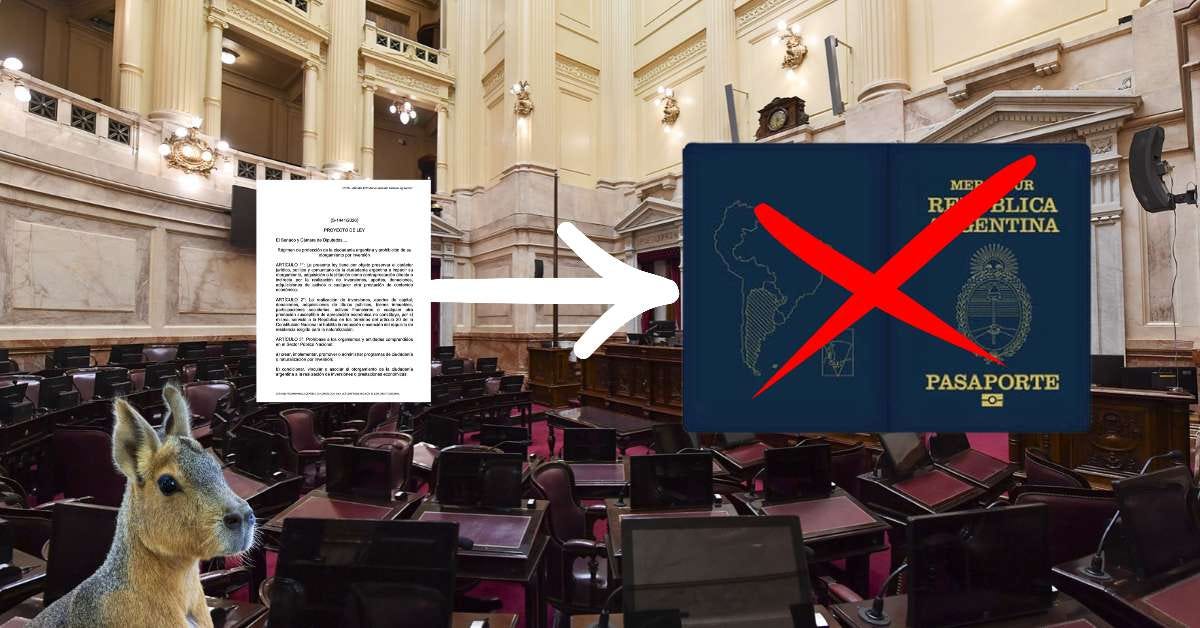
In this article I will go over the details of both bills (together with other pending risks), and why timing will be of the essence once the program is officially “open for business”.
When FT originally came out with the what now turned out to be higher amounts of a $500,000 donation and $1,000,000 zero coupon bond, Senator Jorge Capitanich (from Chaco, Cabinet Chief under Cristina Kirchner) filed a Senate bill on August 24, little over a month later.
Over this weekend after Caputo’s announcement on Friday, two more bills landed in Diputados. One from Agustín Rossi, the last Cabinet Chief under Alberto Fernández, and the only Defense Minister under Cristina Kirchner to ever to lose track of a missile, did not hold back in his bill:
“Our bill repeals the “significant investment” ground introduced by DNU 366/2025 and establishes that no payment, contribution, donation, investment, or purchase of securities may substitute for the residency required to obtain citizenship.
It also dissolves the Citizenship by Investment Programs Agency; prohibits the issuance of public debt securities that grant citizenship or immigration benefits; and prevents the State from hiring intermediaries to market citizenships.”
Tranqui.

The other bill was filed by Florencia Carignano, who ran Migraciones for four years:
“We have introduced a bill with @PaulaPenacca to repeal the citizenship-by-investment scheme and the agency created to administer it.
Argentine citizenship cannot become a commodity to be exchanged for money or a mechanism to attract capital.
The bond with our country cannot be bought; it is built through residency, integration, and putting down roots.”
Migraciones is the office that would sign off on every CBI file.
The details of Carignano’s proposed bill are still unknown, since the last update on the Diputados site was on the 29th. Surely tomorrow or early next week we will be able to read the details of her proposal, which will probably be in line with Capitanich and Rossi bills, but could contain more details since she is very familiar with residency and citizenship in Argentina.
In a nutshell, these are the three ways Peronism wants to kill Argentina’s CBI program, before it even started (as of today, there is still nothing published about regs in the Official Gazette):
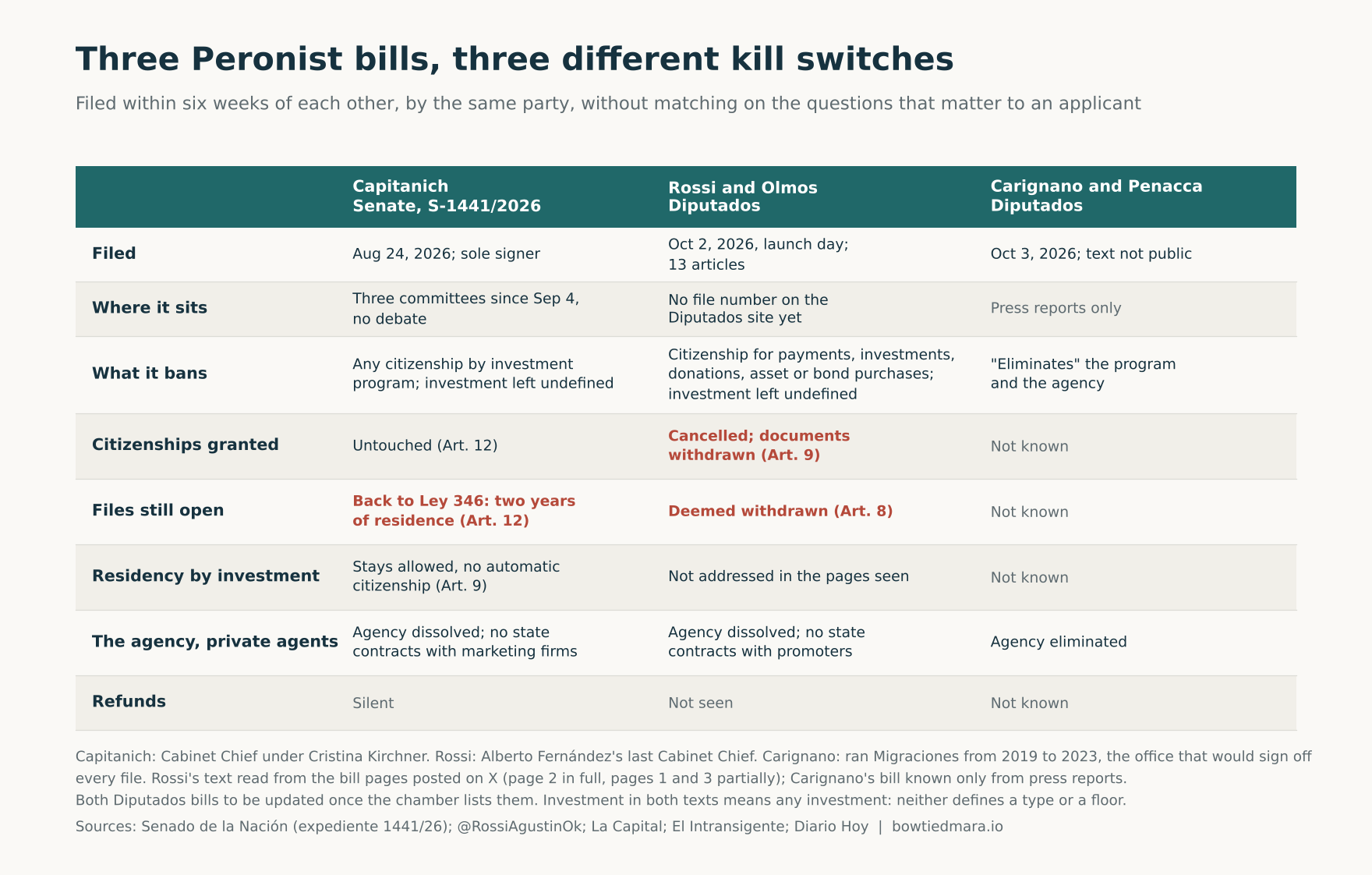
All this is before we get to the court ruling from June, that already knocked the floor out from under Milei’s decree that the whole CBI stands on. In this free article I will go over the details of these proposals and what we know so far.
The Capitanich Senate Bill
S-1441/2026 would ban any citizenship by investment program, put the two-year residence rule back into Ley 346, repeal the investment articles of DNU 366/2025 and all of Decree 524/2025, dissolve the citizenship agency, and forbid the state from hiring or licensing private firms to market citizenship (sorry, agents).

The Capitanich bill was sent to three committees on September 4, but has sat there since without any movement. The details of the text are very interesting for potential CBI investors, because he specifically details that “acquired rights” (Article 12) should be kept. Meaning, if you obtained Argentine citizenship through the CBI program and your application is final, you get to keep the citizenship.
Another interesting part is that investment applications without a final decision (resolución firme) on the day his law would take effect go back to the ordinary rules. That means two years of residence and then citizenship.
So the hardest text in the Senate respects derechos adquiridos (acquired rights), which is a long-standing tradition in Argentine law. What you already hold, a later law does not take away.
The exposed group is the CBI applicants with a file still open; and the article says nothing about a donation already paid, by the way. None of the three texts does.
There is a strong precedent on how Argentina treats open files, and Milei’s own government wrote it: in his 366/2025 decree that moved naturalization from the courts to Migraciones, all the open citizenship applications though the courts carry on and go to a judge. All the new ones after the decree date go to Migraciones.
That said, there are no guarantees, and the Capitanich bill says nothing about open cases who already wired the $350,000 donation but haven’t received their citizenship yet.
One thing that’s noteworthy in the Capitanich text is that he does open the door to residency by investment in Article 9:
The provisions of this Law do not prevent Congress from establishing or maintaining temporary or permanent residency regimes designed to promote productive investments, provided that such regimes: a) do not automatically grant citizenship; b) do not, in and of themselves, lower the constitutional and legal requirements for naturalization; c) verify the lawfulness and traceability of funds; d) establish controls to prevent money laundering, the financing of terrorism, and other economic crimes; e) respect the jurisdiction of the provinces and the Autonomous City of Buenos Aires; and f) do not grant exceptions to the limits established by Law 26.737 regarding the ownership or possession of rural land.
This particular bill is not something to freak out about too much, because for it to become law it needs a majority in both chambers, and bills that get that far rarely arrive the way they were filed.
So far it has had no committee debate, and it will be hard for Capitanich to get the votes required to get something like this through, but the fact that there are three proposals to ban the CBI within a span of two months already tells you that if Milei is not reelected, the program stands on weak ground.
The Rossi Diputados Bill
Rossi posted his text on X on October 2, the same day as the launch: 13 articles under the title Ley de Prohibición de la Venta de la Ciudadanía Argentina.

Carignano's bill was filed the next day but that text is not yet available, but her press release on X says that it eliminates the CBI program and the Agency responsible for it.
The Rossi bill goes full scorched earth compared to the lighter Capitanich bill that only takes away the granting of citizenship by investment: Article 8 of Rossi’s bill says that all open files “count as withdrawn”, full stop.
His Article 9 says that citizenships already granted through investment carecen de validez (are not valid), and orders Migraciones and the Registro Nacional de las Personas to cancel the documents. His reasoning is that President Milei had no power to legislate citizenship issues by decree (a similar reasoning upheld by the Cámara Electoral that declared the decree unconstitutional).

A lawyer friend who reads these things for a living sent me two notes after going through the Rossi bill:
It bans citizenship in exchange for "investments" without ever saying what an investment is;
3 bills on the same subject from the same party in six weeks, with different answers on acquired rights, on open files and on residency.
The opposition to Milei in Argentina does not seem to talk much to each other.
The Court Case
On June 30 the Cámara Nacional Electoral declared DNU 366/2025 null, nulidad absoluta e insanable, void from inception.
The court’s arguments are that citizenship creates political rights, which are an electoral matter, and the Constitution forbids decrees on electoral matters.

The court then notified every federal electoral judge in the country so the criterion would stick everywhere. I covered the ruling in The Shopkeeper Who Broke Argentina's Golden Passport and the government's 36-page appeal in The Empire Files Back.
Why is this even more important than the three bills that would still have to be approved by both chambers? If the Corte Suprema confirms the nullity, the CBI route disappears with the rest of the decree (good news for residents who did leave for a couple of days and want to naturalize, since they would then be able to do so through the original route).
As of today, the Supreme Court has not responded to the case. Judging from the last ruling over the Ley de Tierras decree I discussed in The Cap is Gone this week, that took over 1 year for the Court to pick it up. One year from now is election time in Argentina, so it seems unlikely that the Corte would be dealing with this CBI case then.

If a filing is initiated under a decree declared void by the Supreme Court presents a much more difficult situation than a law change that still respects citizenship granted through investments. There is also no way of knowing what will happen with the money in this case.
Knowing the Argentine system well, applicants would probably have their documents cancelled before seeing their donation or bond money back.
![[ ESCENA DE PELÍCULA ] ¿Esto era para cobrar? ... Te lo vas a tener que meter en el c..o #Marquitos #NueveReinas #CineDeColecciónNacional #MeVuelvoLoco | Diario Crónica | Facebook](https://substackcdn.com/image/fetch/$s_!N5AL!,f_auto,q_auto:good,fl_progressive:steep/https%3A%2F%2Fsubstack-post-media.s3.amazonaws.com%2Fpublic%2Fimages%2F757be418-a039-4462-a8d3-0f9bcc3c0b25_576x320.jpeg "[ ESCENA DE PELÍCULA ] ¿Esto era para cobrar? ... Te lo vas a tener que meter en el c..o #Marquitos #NueveReinas #CineDeColecciónNacional #MeVuelvoLoco | Diario Crónica | Facebook")
The Odds
Low. At least for now. Peronism was crushed pretty badly in the midterms in 2025, and now only holds 25 of 72 Senate seats (the lowest level since 1983).
Say a CBI ban gets through both chambers anyway. Milei would veto it, and to override that decree would need another two thirds in each chamber.
Besides these low legislative odds, the bills also have an expiry date: a bill that has not passed its chamber of origin, lapses by the end of the parliamentary year after its filing. For both 2026 bills that is February 29, 2028. To stay alive, S-1441 needs the Senate to pass it during 2027, an election year, with 25 votes against 45. Lol.
The date that matters is December 10, 2027 (the start of the next government). Presidential elections are held in October and Milei’s first term ends in December.
The CBI Calendar
When looking at these threats together, we get a clear picture of the best filing window:
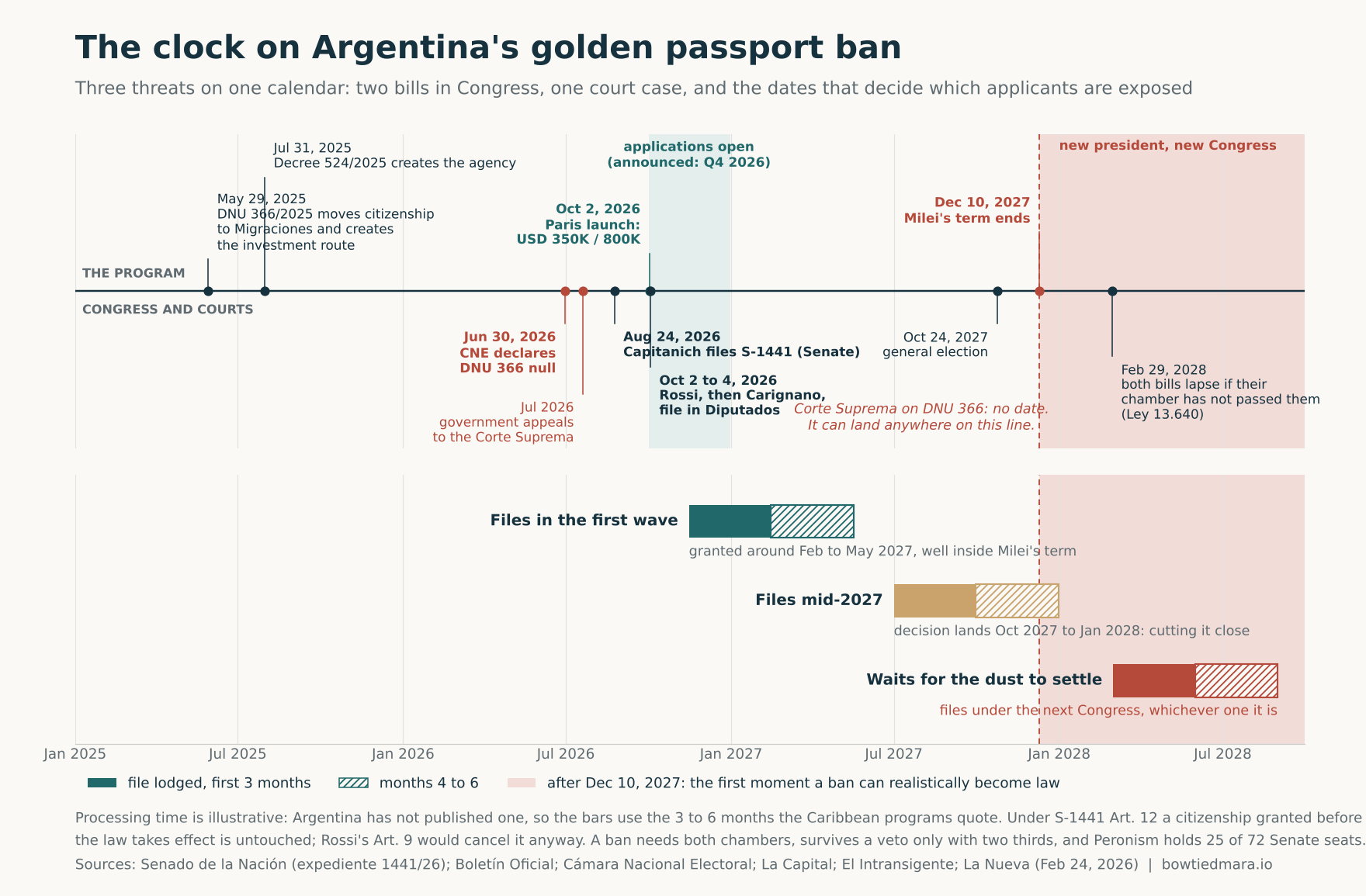
Argentina has not published the processing times, so the bars used in the graph use the standard timelines of the Caribbean programs (3 to 6 months). That gives us three applicant paths:
If you submit the application in the first wave (and assuming a reasonable processing time) the decision would arrive in the first half of 2027, meaning it would fall squarely within Milei’s term;
If you submit it in mid-2027, the decision would coincide with the election season—a typically turbulent period when little administrative progress is made—leaving a very tight timeframe;
Alternatively, you could wait for the situation to become clearer and for there to be certainty regarding Milei’s continuity, in order to submit the application to the next Congress.
Important sidenote is that none of these timelines take a Supreme Court ruling into account, which could potentially undo the whole decree.
The table below walks through different scenarios from left to right, with different outcomes depending on the stages:
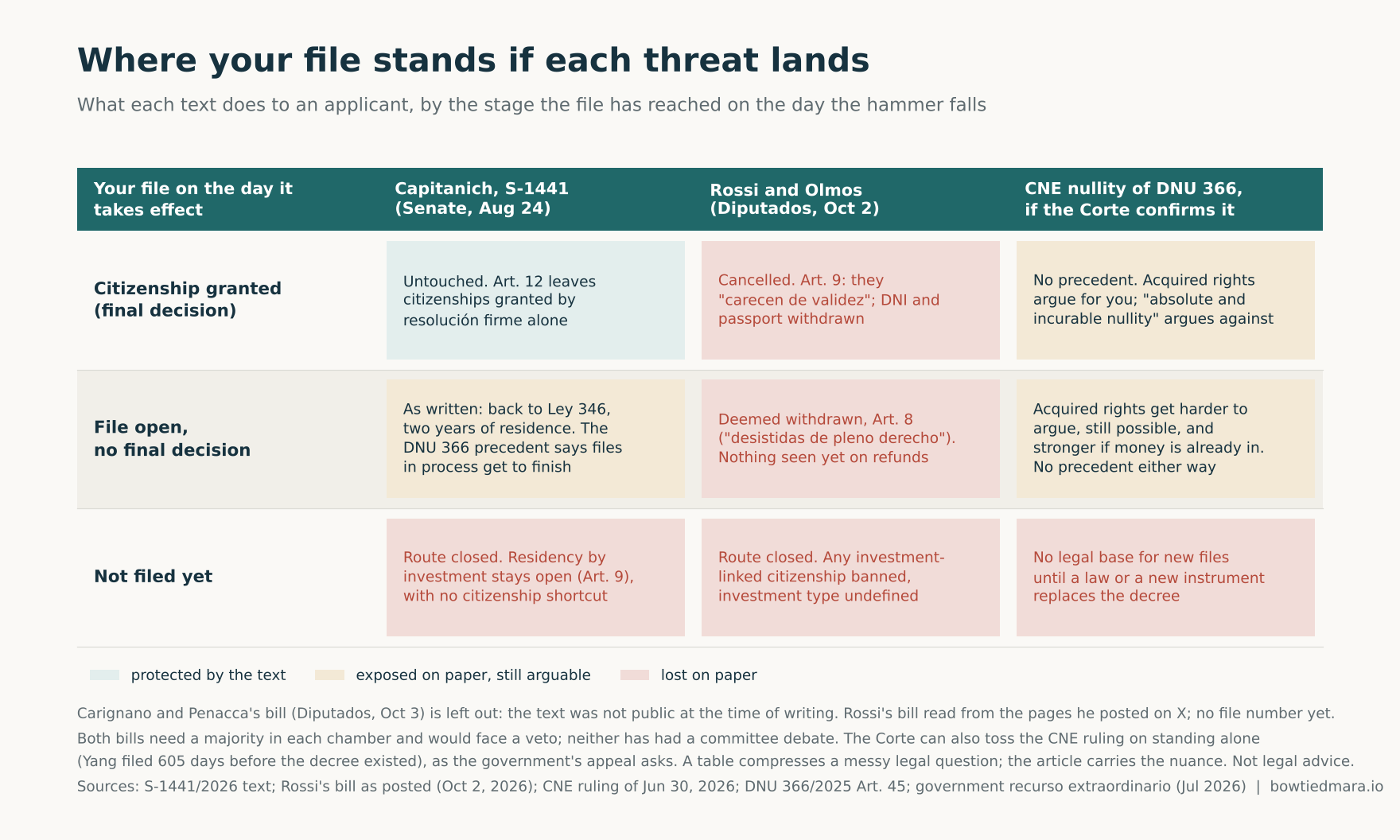
Rossi’s bill is the harshest on paper, the Capitanich bill is the mildest. The Supreme Court ruling has no calendar and no precedent.
Final Thoughts
The conclusion from all this is fairly simple: either move fast on your application, or don’t apply at all if you think these risks are too much of a gamble. As of today, time is not working in anybody’s favor, since the Argentine government has made various announcements but has not yet published any regulation or final program requirements in the Official Gazette.
Until that happens, there is no way to apply. Caputo has promised Q4, so the final regulation should be ready in the coming days if not weeks.
With regards to the threats, under the Senate text, you would be protected if your citizenship is granted before the end of 2027. If you have filed but are still waiting, precedent would be on your side. The person with the most to lose is the one who waits until 2027 to start. The Corte/CNE is the risk I cannot calendar for you, and the honest answer is that nobody can.
If you are seriously considering the program as soon as the final regulation is published, join the waitlist to book an eligibility call once the portal opens.
Let me know in the comments if any of these risks change your math.
See you in the Jungle, anon!
BowTiedMara covers Argentine macro, real estate, citizenship and residency, and sovereign individual strategy from the ground in Buenos Aires. For 1x1 consultations on residency, citizenship, and investing in Argentina, or to follow along on X and YouTube, see the links below.
1x1 Consultations: book a 1x1 consultation for more information about obtaining residency, citizenship or investing in real estate in Argentina here.
Propertyinbuenosaires.com: personal resource website with everything you need to know about buying and selling property in Argentina.
ArgInvesting.com: new project — a mini-Bloomberg for Argentina. Live FX, BCRA, inflation and bond data with interactive charts, plus the full Macro Pulse report. Built off the Argentina Macro Pulse you’ve read here.
X/Twitter: definitely most active here, you can also find me on Instagram but I hardly use that account.
Podcasts: You can find previous appearances on podcasts etc here.
YouTube: Check out my channel for real estate info and more.
WiFi Agency: My other (paid) blog on how to start a digital agency from A to Z.